
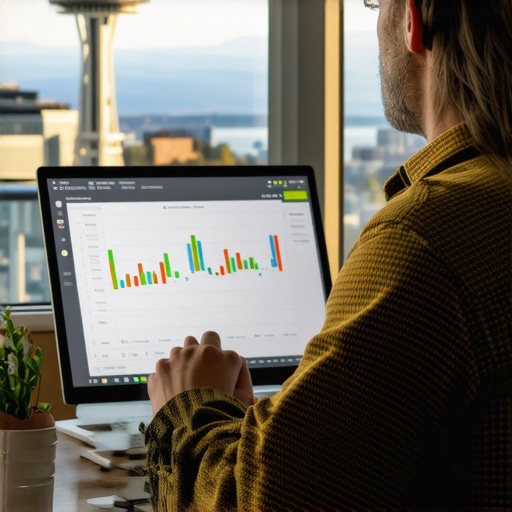
How Most Rank Trackers Give Seattle Business Owners a False Sense of Security
You open your email on a Monday morning and find a report from your SEO agency. It’s filled with green arrows, “Up” notations, and a bold claim: Rank #1 for “Plumber Seattle.” You feel a momentary surge of pride, but then you look at your call log. The phone hasn’t rung in two days. The leads aren’t coming in. You start to wonder: if I’m #1, why am I not busy?
As an expert in Google Business Profile optimization, I see this paradox every single week. My name is Mary Licon, and I’ve spent years deconstructing how Google treats local businesses in high-density markets like the Pacific Northwest. The truth is uncomfortable: most rank trackers are lying to you. They aren’t necessarily doing it maliciously, but they are providing a static, “sanitized” version of reality that doesn’t exist for a real user walking down 1st Avenue or stuck in traffic on I-5.
Traditional rank trackers check your position from a single data center or a fixed zip code centroid. This creates a “Green Report Paradox” where your software says you’re winning the city, while your actual customers can’t even find you from the next neighborhood over. To understand why your phone is silent despite a “perfect” report, we have to look at Why Your Local SEO Report is Lying About Your Actual Seattle Map Rank.
Why Standard Rank Trackers Fail in the PNW
The core of the problem lies in one word: Proximity. In the world of google business profile seo, proximity is arguably the most powerful – and most volatile – ranking factor. Google’s primary goal is to provide the most convenient solution to the user. If someone searches for “emergency roof repair” while standing in South Lake Union, Google is going to prioritize businesses that are physically closest to that user, provided they meet a baseline of relevance and prominence.
Standard rank trackers fail because they lack “spatial awareness.” They might ping Google’s servers from an IP address located in a data center in Virginia, or they might simulate a search from the exact center of the 98101 zip code. But Seattle isn’t a single point on a map; it is a sprawling, topographically complex region. Research consistently shows that proximity is a top three ranking factor. A business might rank #1 at their own front door in Interbay, but drop to #10 just three blocks away near the Space Needle.
When a tracker gives you a single number – say, “Rank #3” – it is averaging data that shouldn’t be averaged. It’s like saying the average temperature in Washington is 55 degrees; that doesn’t help you if you’re standing in a blizzard on Mt. Rainier or enjoying a heatwave in Spokane. For a detailed breakdown of this phenomenon, read Why Proximity is Quietly Sabotaging Your Washington Local SEO Results.
The Seattle Neighborhood Trap
Seattle presents a unique challenge for rank google business profile strategies because of its distinct geography. We are a city of hills, water, and very defined neighborhood boundaries. In many cities, a “zip code” is a decent proxy for a service area. In Seattle, zip codes are often meaningless compared to neighborhood identity.
Consider the “ranking pockets” created by our terrain. A contractor based in Ballard might have incredible authority, but because of the Ship Canal and the bottleneck of the Fremont Bridge, Google’s algorithm often treats Queen Anne and Magnolia as entirely different ecosystems. If your rank tracker says you rank in “Seattle,” it is being too broad. “Seattle” is a massive target. Are you ranking in Capitol Hill? Are you ranking in Columbia City? Are you ranking in West Seattle, where the “bridge effect” often isolates local search results from the rest of the city?
Standard tools treat the city as a flat, unobstructed plane. They don’t account for the fact that a user in Laurelhurst is unlikely to drive to West Seattle for a coffee, and Google knows this. This is why Why Neighborhood Signals Now Outrank Traditional Zip Code Targeting in Seattle is essential reading for any local business owner who wants to dominate the Map Pack.
The Proximity Filter vs. Authority
There is a “3-6 mile” reality that most SEO agencies don’t want to talk about. In a dense urban environment like Seattle, the “Proximity Filter” is incredibly tight. Unless you have massive brand authority, Google is hesitant to show your business to someone more than 5 miles away if there are competent competitors closer to the user.
Most businesses struggle to maintain a top-3 position beyond a very narrow radius. To break through this “proximity wall,” you need to leverage the other two pillars of Google’s local algorithm: Prominence and Relevance. If your local seo tools aren’t showing you the exact radius where your rankings drop off, you are flying blind. You might be spending thousands of dollars trying to rank for keywords in Bellevue when your physical location in Shoreline makes that nearly impossible without a specific “authority-building” strategy.
Traditional trackers don’t tell you where the “wall” is. They just give you a number. This leads to wasted ad spend and frustrated business owners. You can learn how to fight back against this in our guide: Stop Relying on Proximity: How to Build Map Authority When Your Competitors Are Closer.
Interaction Signals: The 2026 Ranking Factor
As we look toward 2026, the “lie” told by standard trackers gets even more dangerous. Google is moving away from static signals like “citations” (your name, address, and phone number listed on random directories) and toward Interaction Signals. Google wants to see “real world” proof that people like your business.
What are Interaction Signals?
- Click-Through Rate (CTR): How many people click your profile vs. your competitors?
- Request for Directions: How many people are actually asking Google Maps to navigate to your storefront?
- Photo Views: Are users engaging with your visual content?
- Dwell Time: How long do people look at your profile before making a decision?
Standard google maps rank tracker software cannot measure these behavioral nuances. They can tell you where you “sit” on the shelf, but they can’t tell you if people are actually reaching for your product. In 2026, a business with a lower “technical” rank but higher interaction signals will often leapfrog the “optimized” profile that no one clicks on. This shift is explored deeply in 3 Interaction Moves That Finally Force a Seattle 3-Pack Win. Effective google business profile optimization now requires a focus on conversion, not just position.
The Solution: Geo-Grid Tracking
If standard trackers are failing you, what is the alternative? The answer is Geo-Grid Tracking. This is the only “honest” way to see your performance in the Seattle market. Instead of a single rank number, a geo-grid gives you a visual map of the city overlaid with a grid of GPS coordinates.
At each point on the grid, the tool performs a hyper-local search. You might see a “1” over your office in South Lake Union, a “3” near the Spheres, and a “14” by the time you get to the Olympic Sculpture Park. This visual data reveals your “blind spots.” It shows you exactly where your authority ends and where your competitors begin to take over. Using SEO Viper Tools or similar local seo ranking tools allows you to see the “blooms” of your ranking. If you see a sea of red (low rankings) just a mile away from your office, you know you have a proximity problem that no amount of keyword stuffing will fix.
Geo-grids allow you to stop guessing. You can see if a specific marketing campaign actually expanded your “ranking bubble” or if it just inflated a vanity metric on a static report. For Seattle businesses, where traffic and geography dictate consumer behavior, this level of granularity isn’t a luxury – it’s a necessity for survival.
Conclusion & Action Plan
The “Green Report” is a security blanket that keeps you from seeing the holes in your local marketing strategy. If you are a Seattle business owner, you cannot afford to rely on “average” rankings. You need to know how you perform at the street level, neighborhood by neighborhood.
It is time to stop looking at reports that tell you what you want to hear and start looking at data that tells you what you need to know. Your first step should be to move away from legacy trackers and toward a system that prioritizes geo-spatial data and interaction signals. Use a google business profile audit tool to identify where your profile is failing to convert the few people who *do* see it.
Don’t let a false sense of security sink your business. The Seattle market is too competitive for “good enough” SEO. Demand transparency, look at the grids, and focus on the signals that actually drive phone calls. If you’re ready to see the truth about your rankings, check out The Exact Checklist We Use to Audit Ghosted Seattle Map Profiles and start reclaiming your local territory today.