
Why Your Local SEO Report is Lying About Your Actual Seattle Map Rank
You open your monthly marketing report and see a green arrow pointing upward next to a bold statement: “Rank #1 for Plumber in Seattle.” You breathe a sigh of relief, assuming your google business profile seo is firing on all cylinders. But then, you walk three blocks down from your office in Ballard, pull out your phone, and search for your own business. You aren’t #1. In fact, you aren’t even in the top three. You’re ghosted. This is the reality of the “Proximity Paradox,” a phenomenon where traditional SEO reporting creates a false sense of security while your actual local map pack seo is failing just a mile away. In the hyper-competitive Seattle market, being #1 in Ballard doesn’t mean you’re #1 in Capitol Hill, and it certainly doesn’t mean you’re capturing the lucrative traffic from South Lake Union. Most agencies are selling you a snapshot of a single data point, but to rank google business profile listings effectively, you need to understand that “Seattle” isn’t one ranking – it’s thousands of tiny, neighborhood-specific battles.
The Myth of the “City-Wide” Ranking in Seattle
For years, business owners have been conditioned to chase the “City + Keyword” ranking. However, Google Maps doesn’t operate on city boundaries; it operates on meters and minutes. The “Proximity Paradox,” a concept popularized by experts at Search Engine Land and refined by technical SEOs in the PNW, explains that Google’s distance bias is so aggressive that a weaker, less optimized business can outrank a dominant brand simply by being 0.5 miles closer to the searcher. To rank higher on google maps, you have to realize that there is no such thing as a “Seattle” rank. There is only a “Where is the searcher standing?” rank.
Consider a law firm located in South Lake Union. Their SEO report might show them as the top result for “personal injury lawyer.” While they might hold that spot for a searcher standing on the Amazon campus, that visibility likely evaporates the moment a potential client searches from West Seattle or Magnolia. Standard rank trackers often use a single IP location – usually a data center or a fixed point in the city center – to pull data. This creates a “false positive.” You see a #1 rank because the tool is “standing” right on top of your office, but your customers are searching from the I-5 corridor during their commute or from their homes in Queen Anne. This discrepancy is why your local map pack seo might look great on paper but feel non-existent in your lead flow.
Google’s algorithm prioritizes relevance, distance, and prominence. In a dense urban environment like Seattle, where the geography is interrupted by Lake Union, Elliott Bay, and the Ship Canal, “distance” is calculated with extreme granularity. If your reporting doesn’t account for these geographic hurdles, you aren’t seeing your business; you’re seeing a mirage.
Why Standard Rank Trackers Fail the “Ballard Test”
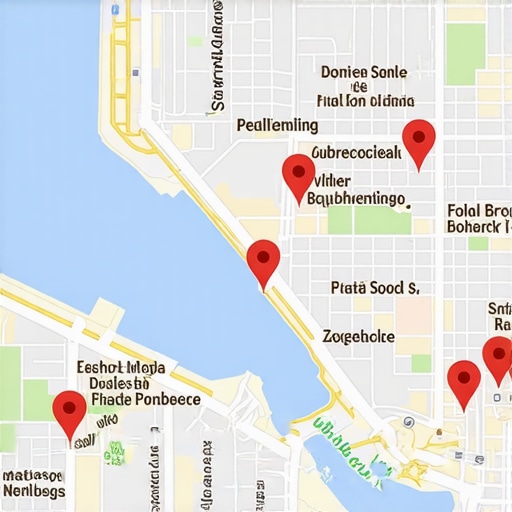
Traditional SEO tools were built for organic blue links, not the dynamic, shifting sands of the Google Map Pack. When you use a generic google maps rank tracker, it often queries Google from a single GPS coordinate. We call the failure of this method the “Ballard Test.” If you are a boutique in Ballard, a standard tracker might tell you that you are ranking perfectly. However, if that tracker isn’t testing visibility from Fremont, Wallingford, and Greenwood, it is missing 80% of your potential market. To truly understand your reach, you must use google maps rank tracker technology that utilizes a GeoGrid – a multi-point coordinate system that simulates searches from every street corner.
Most business owners are unaware that Why Most Local SEO Reports Ignore the Only Map Signal That Actually Drives Calls is often due to this lack of spatial data. If your agency isn’t showing you a grid of green, yellow, and red dots across a map of the Puget Sound, they are hiding the truth. Traditional local seo tools are simply too blunt for the surgical precision required in 2025 and 2026. A 13×13 grid covering a 5-mile radius of Seattle provides 169 distinct data points. Only then can you see that while you dominate the 3-pack within a two-block radius of your shop, your visibility drops off a cliff once you cross 15th Ave NW. This “visibility cliff” is where your revenue is dying, and standard reporting will never show it to you.
2026 Ranking Signals: It’s No Longer Just About Proximity
As we move toward 2026, the algorithm is shifting again. While proximity remains a heavyweight factor, “User Behavior Math” and “Interaction Signals” are beginning to outrank simple distance. Google is increasingly using “agentic” search – predicting what a Seattleite wants based on their specific neighborhood habits. For example, if users in Belltown frequently click on a specific coffee shop despite it being slightly further away than a competitor, Google will expand that shop’s “proximity radius.” This is google business profile optimization at a level most agencies haven’t even considered.
Technical insight suggests that hyper-local check-ins, real-time inventory data (e.g., a hardware store in SODO showing “in-stock” for a specific tool), and even neighborhood-level sentiment analysis are becoming core pillars. Expert SEO Tylor Bennett notes, “Google isn’t ranking businesses; it’s ranking behavior. If your profile doesn’t trigger a ‘local intent’ response through consistent interaction signals, no amount of keyword stuffing will save your 3-pack rank.” To improve google maps ranking in this environment, you must move beyond static NAP (Name, Address, Phone) consistency and start focusing on “Neighborhood Signals.”
In 2026, the “Commuter Proximity Bias” will also play a larger role. Google knows where people live and where they work. If a searcher in Shoreline searches for a “dentist” while at their office in Downtown Seattle, Google might show results along their likely commute path. If your google business profile seo strategy doesn’t account for these behavioral patterns, you are essentially invisible to the modern, mobile consumer.
How to Audit Your “Real” Visibility (The GeoGrid Approach)
If you want to stop guessing and start growing, you need to perform a real audit. This isn’t about looking at a PDF; it’s about using high-end local seo tools to visualize your digital footprint. The GeoGrid approach is the only way to see the “blooms” of your visibility. When you run a google business profile audit tool, you should be looking for where your “green zone” (Rank 1-3) ends and your “red zone” (Rank 4+) begins.
Here is the step-by-step process for a modern Seattle map audit:
- Step 1: Identify your top 5 high-intent keywords (e.g., “emergency plumber Seattle,” “drain cleaning Ballard”).
- Step 2: Use a google business profile audit tool to run a grid search. We recommend at least a 7×7 grid for neighborhood focus or a 13×13 grid for city-wide analysis.
- Step 3: Analyze the “Centroid Shift.” Is your ranking strongest at your office, or is it pulled toward a specific high-traffic area?
- Step 4: Compare your grid against your top three competitors. Often, you’ll find a competitor is “stealing” your traffic in a specific neighborhood like Queen Anne because they have localized content that you lack.
By following The Exact Checklist We Use to Audit Ghosted Seattle Map Profiles, you can identify exactly which local seo software metrics are failing you. If your grid shows a sea of red just outside your parking lot, your google business profile optimization is likely suffering from a lack of local authority or “Interaction Math” signals.
3 Red Flags Your SEO Agency is Hiding Map Data
If you are working with a marketing firm, you need to be your own advocate. Many agencies use outdated local seo software because it’s cheaper and allows them to report “wins” that don’t actually result in phone calls. Here are three red flags that your agency is hiding the truth about your Seattle rankings:
- They only show “Average Position”: This is the biggest lie in local SEO. If you are #1 at your office and #20 everywhere else in Seattle, your “average” might look like a #10. But #10 gets zero calls. You need to see the distribution, not the average.
- They don’t show “Searcher Proximity” maps: If they aren’t providing heat maps or GeoGrids, they aren’t doing local map pack seo. They are doing basic organic SEO and hoping you won’t notice the difference.
- They ignore “Map Interaction” metrics: Rankings are a vanity metric if they don’t lead to actions. A real report should correlate your grid visibility with “Direction Requests,” “Website Clicks,” and “Click-to-Calls” directly from the GBP dashboard.
Understanding Why Proximity is Quietly Sabotaging Your Washington Local SEO Results is essential for any business owner who wants to hold their agency accountable. Demand transparency. Demand a GBP ranking tools report that shows your standing in the neighborhoods that actually matter to your bottom line.
Conclusion: Reclaiming Your Seattle Map Dominance
A lie in your SEO reporting isn’t just a technical error; it’s a loss of revenue. Every day that you believe a false #1 ranking is a day you aren’t optimizing for the customers who are actually searching for you in Capitol Hill, Fremont, or West Seattle. The “Proximity Paradox” is real, but it is also an opportunity. By using a sophisticated google maps rank tracker and embracing GeoGrid reporting, you can see exactly where your competitors are vulnerable and where you can expand your reach.
To win the Seattle 3-pack, you must move beyond the basics. You need to implement the 4 Neighborhood Signals Winning the Google 3-Pack Seattle [2026] and focus on building a profile that Google trusts across the entire city, not just in your immediate zip code. Stop settling for “average” rankings and start demanding local dominance. Whether you are a plumber in SODO or a law firm in Bellevue, the path to more leads starts with honest data.
Ready to see your real rank? It’s time to stop guessing. Start Mastering Seattle SEO in 2025: Expert Strategies for Local Ranking by auditing your profile today. Visit SEO Viper Tools to get a transparent look at your grid and start claiming the Seattle market share you’ve been missing.